Moussaka
Μουσακάς
Ingredients
Eggplant
- 1.2 kg 2.6 lb eggplant
- 80 ml 5.5 tbsp olive oil
- 1 to taste 1 to taste salt
Meat Sauce
- 45 ml 3 tbsp olive oil
- 2 large 2 large onion
- 4 cloves 4 cloves garlic
- 700 g 1.5 lb ground meat beef-pork mix (kimas)
- 400 g 14 oz canned tomatoes
- 30 g 2 tbsp tomato paste
- 5 g 1 tsp sugar
- 1 tsp 1 tsp cinnamon
- 0.5 tsp 0.5 tsp allspice
- 1 tsp 1 tsp dried oregano
- 1 to taste 1 to taste salt
- 1 to taste 1 to taste black pepper
Bechamel
- 80 g 5.5 tbsp butter
- 80 g 0.67 cups all-purpose flour
- 800 ml 3.3 cups milk
- 2 large 2 large eggs
- 0.25 tsp 0.25 tsp nutmeg
- 0.5 tsp 0.5 tsp salt
- 1 pinch 1 pinch black pepper
- 40 g 0.33 cups kefalotyri (grated, optional)
About This Dish
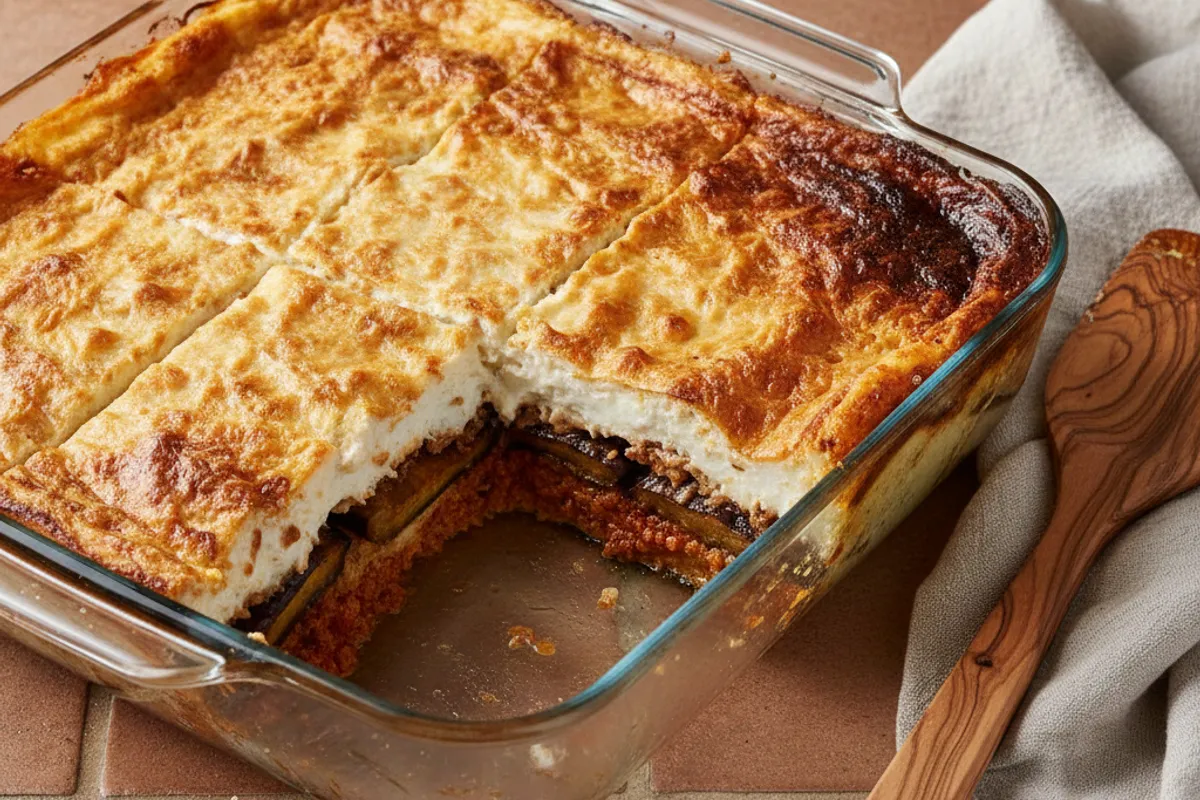
Moussaka (μουσακάς, pronounced moo-sah-KAHS) is arguably the most recognized dish of Greek cooking, a layered casserole of roasted eggplant, spiced meat sauce, and thick bechamel that has been baked in Greek home kitchens for generations. While versions of the dish exist across the eastern Mediterranean and Balkans, the modern Greek moussaka — with its signature bechamel topping — was codified in the 1920s by Nikolaos Tselementes, a French-trained Greek chef who shaped 20th-century Greek culinary identity. His addition of the cream sauce transformed a simpler Ottoman-era eggplant-and-meat bake into the layered, gratineed casserole known today.
The dish is built on a few straightforward components that reward careful preparation. The eggplant must be properly salted and roasted until deeply golden. The meat sauce — kimas (κιμάς), a blend of beef and pork — is simmered with cinnamon (κανέλα) and allspice (μπαχάρι), the warm spices that distinguish Greek meat cookery from its western European counterparts. The bechamel is enriched with egg yolk and freshly grated nutmeg (μοσχοκάρυδο), giving it enough body to set into a clean, sliceable layer. Assembled and baked, then rested until the layers firm, moussaka is home cooking at its most generous — a dish meant to feed a table of people from a single pan.
Instructions
-
Slice the eggplants lengthwise into planks about 7 mm (0.3 inches) thick. Lay them on a wire rack set over a sheet pan, sprinkle both sides generously with salt, and leave for 30 minutes. Beads of brown liquid will form on the surface — this draws out bitterness and excess moisture.
-
Preheat the oven to 200C (400F). Pat the eggplant slices dry with paper towels, pressing firmly. Brush both sides lightly with olive oil and arrange in a single layer across two sheet pans.
-
Roast the eggplant for 25-30 minutes, flipping once halfway through, until golden brown and soft. The slices should be deeply coloured but still hold their shape. Set aside and reduce the oven to 180C (350F).
-
While the eggplant roasts, start the meat sauce. Heat 45 ml (3 tbsp) olive oil in a large, deep pan over medium-high heat. Add the onions, finely diced, and cook until soft and translucent, about 8 minutes. Add the minced garlic and cook for 1 minute until fragrant.
-
Add the ground meat and break it apart with a wooden spoon. Cook, stirring occasionally, until well browned and the liquid has evaporated, about 10 minutes. Do not rush this step — the meat should sizzle and develop colour, not steam in its juices.
-
Stir in the tomato paste and cook for 1 minute. Add the canned tomatoes, crushing them by hand as they go in. Add the cinnamon, allspice, dried oregano, sugar, salt, and black pepper. Stir well.
-
Bring the sauce to a simmer, then reduce the heat to low. Cook uncovered for 20-25 minutes, stirring occasionally, until the sauce is thick and most of the liquid has cooked off. It should be moist but not runny — excess liquid will make the assembled moussaka soggy. Taste and adjust seasoning. Set aside.
-
Make the bechamel. Melt the butter in a medium saucepan over medium heat. Add the flour all at once and whisk continuously for 2 minutes to cook out the raw flour taste. The roux should be pale and bubbling but not browned.
-
Begin adding the milk in a slow, steady stream, whisking constantly to prevent lumps. After all the milk is incorporated, continue whisking over medium heat until the sauce thickens and just begins to bubble, about 8-10 minutes. It should coat the back of a spoon thickly.
-
Remove the bechamel from the heat. Stir in the nutmeg, salt, and pepper. Let it cool for 5 minutes, stirring occasionally. In a small bowl, beat the eggs lightly, then whisk a few spoonfuls of the warm bechamel into the eggs to temper them. Pour the egg mixture back into the saucepan, whisking quickly to combine. The bechamel should be smooth, thick, and glossy. If using kefalotyri, stir in half now and reserve the rest for the top.
-
Lightly oil a large baking dish, roughly 33 x 23 cm (13 x 9 inches). Arrange half the roasted eggplant slices in a single layer across the bottom, overlapping slightly if needed.
-
Spread the meat sauce evenly over the eggplant in one layer. Top with the remaining eggplant slices in another even layer.
-
Pour the bechamel over the top eggplant layer, using a spatula to spread it evenly to the edges. The bechamel should fully seal the top. If using reserved kefalotyri, scatter it over the surface.
-
Bake at 180C (350F) for 40-45 minutes, until the top is deep golden brown and the edges are bubbling. The bechamel should be set and firm to the touch, not jiggly.
-
Remove from the oven and let the moussaka rest for at least 15 minutes before cutting. This resting time is not optional — it allows the layers to set so the portions hold their shape when sliced. Cut into squares and serve warm.
Tips
- Resting is the difference between moussaka that holds a clean square and moussaka that collapses on the plate. Fifteen minutes is a minimum — thirty is better. Moussaka served warm, not scorching hot, tastes better anyway.
- This dish reheats well. Cover with foil and reheat at 160C (325F) for 20-25 minutes. It can also be assembled a day ahead, refrigerated unbaked, and baked the next day — add 10 minutes to the baking time if going straight from the fridge to the oven.
- Roasting the eggplant rather than frying it produces a lighter result with less oil absorption. If you prefer a more traditional approach, pan-fry the salted slices in olive oil until golden on each side, draining them on paper towels afterward.
- Temper the eggs carefully when making the bechamel. Adding eggs directly to the hot sauce will scramble them. The gradual whisking of hot sauce into the beaten eggs, then returning the mixture to the pot, ensures a smooth, rich result.
- Some Greek cooks sprinkle a thin layer of fine breadcrumbs on the bottom of the dish before adding the first eggplant layer. This absorbs excess moisture and helps the bottom layer crisp slightly.
Seasonal Note
Though eggplant (μελιτζάνα) peaks in the late summer and early autumn, it remains available through the Greek winter months from storage and greenhouse production — and winter is when moussaka truly comes into its own. This is a dish built for cold-weather appetites: rich, warming, and substantial enough to anchor a meal on its own. The warming spices in the meat sauce — cinnamon and allspice, both staples of the Greek pantry — are legacy flavours from the Byzantine spice routes, and they give Greek meat cookery its distinctive character. Paired with a simple salad of seasonal greens dressed in olive oil and lemon, moussaka is Greek winter comfort at its most essential.