Galaktoboureko
Γαλακτομπούρεκο
Ingredients
Custard
- 1000 ml 4.2 cups whole milk
- 200 g 1 cup sugar
- 120 g 0.75 cup semolina (fine)
- 4 large 4 large eggs
- 40 g 3 tbsp butter
- 1 lemon 1 lemon lemon zest
Phyllo
- 400 g 14 oz phyllo dough
- 150 g 5.3 oz butter (melted)
Syrup
- 300 g 1.5 cups sugar
- 300 ml 1.25 cups water
- 30 ml 2 tbsp lemon juice
- 1 strip 1 strip lemon peel (strip)
- 1 stick 1 stick cinnamon stick
About This Dish
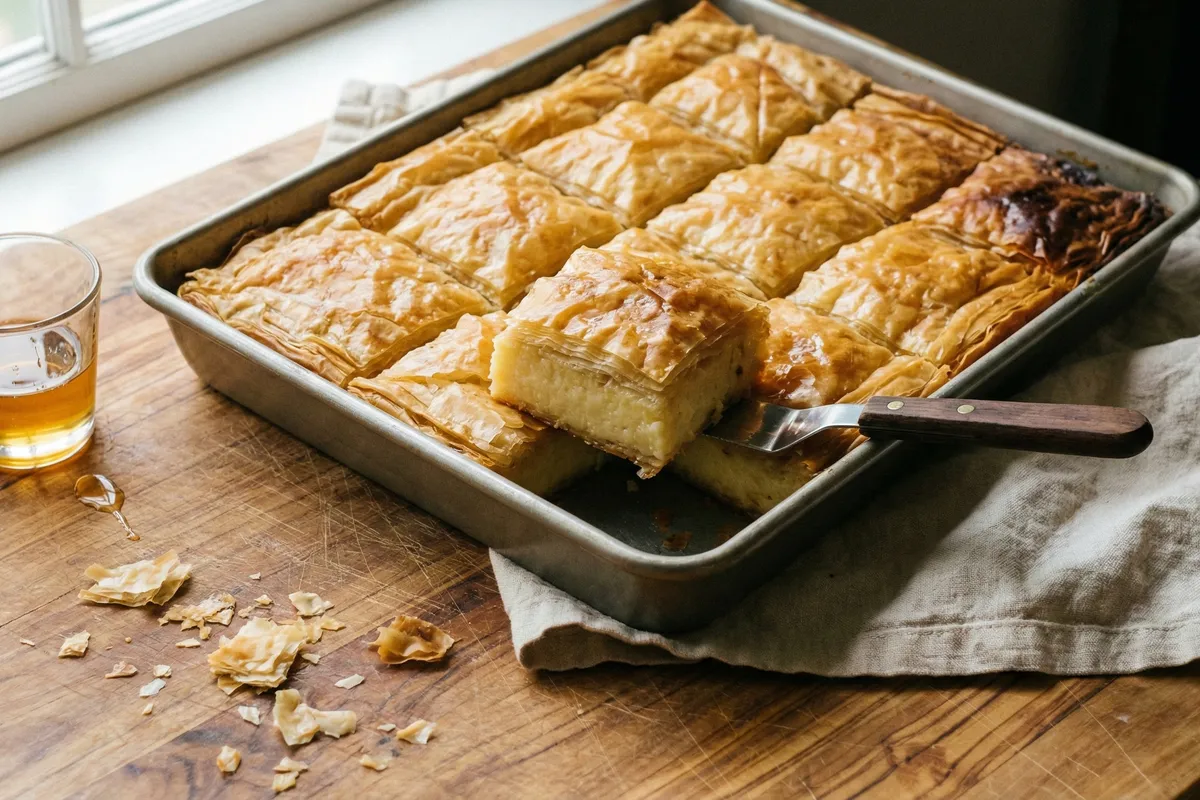
Galaktoboureko (γαλακτομπούρεκο, ga-lak-to-BOU-re-ko) is one of the most celebrated desserts in Greek pastry making. The name breaks down neatly: gala (γάλα, milk) and boureko (from the Turkish börek, a filled pastry). It is exactly that — a thick, lemon-scented semolina custard baked between layers of buttered phyllo dough, then drenched in cold syrup while still hot from the oven. The result is a dessert with shattering, flaky pastry on top and a soft, creamy custard center that holds its shape when sliced but gives way easily on the fork.
Galaktoboureko is found in every zacharoplasteio (ζαχαροπλαστείο, pastry shop) across Greece, from Thessaloniki to Athens to the islands. It appears on family tables for name day celebrations, Sunday meals, and holidays. While it is enjoyed year-round, the dessert feels especially suited to winter, when the kitchen warms from the oven and the bright scent of lemon zest in the custard cuts through the cold. Unlike baklava, which relies on nuts for richness, galaktoboureko is all about milk and semolina — humble pantry ingredients transformed into something remarkable.
Instructions
-
Start with the syrup, as it must be completely cool before you use it. Combine 300 g (1.5 cups) sugar, 300 ml (1.25 cups) water, the strip of lemon peel, and the cinnamon stick in a saucepan. Bring to a boil, stirring until the sugar dissolves. Reduce the heat and simmer for 8-10 minutes until slightly thickened. Stir in 30 ml (2 tbsp) lemon juice. Remove from heat, discard the lemon peel and cinnamon stick, and set aside to cool completely.
-
For the custard, pour the milk into a heavy-bottomed saucepan and bring to a gentle simmer over medium heat. Do not let it boil over — watch it closely.
-
While the milk heats, whisk the eggs and 200 g (1 cup) sugar together in a large bowl until pale and thick, about 2 minutes.
-
Once the milk is simmering, reduce the heat to medium-low. Add the semolina in a slow, steady stream, whisking constantly. Continue whisking for 3-4 minutes as the mixture thickens. It should pull away from the sides of the pan and have the consistency of thick porridge.
-
Remove the saucepan from the heat. Temper the egg mixture: add a ladleful of the hot semolina mixture to the eggs while whisking vigorously. Repeat with two more ladlefuls to gradually raise the temperature of the eggs.
-
Pour the tempered egg mixture back into the saucepan, whisking constantly. Return to low heat and stir for 1-2 minutes until the custard is thick and smooth. Do not let it boil.
-
Remove from heat. Stir in 40 g (3 tbsp) butter and the zest of one lemon. The butter should melt completely into the custard. Cover the surface with cling film to prevent a skin from forming. Set aside.
-
Preheat the oven to 180°C (350°F). Brush a 30 x 20 cm (12 x 8 inch) baking pan with melted butter.
-
Lay one sheet of phyllo dough in the pan, letting any excess drape over the sides. Brush generously with melted butter. Repeat with half of the phyllo sheets (about 6-7 sheets), brushing each one with butter. The sheets should extend slightly beyond the pan edges.
-
Pour the warm custard over the phyllo base and spread it evenly with a spatula.
-
Layer the remaining phyllo sheets on top of the custard, again brushing each sheet with melted butter. Tuck or fold any overhanging edges inward to seal the pie. Brush the top sheet generously with butter.
-
Using a sharp knife, score the top layers of phyllo into 12 pieces — either squares or traditional diamond shapes. Cut through only the top phyllo, not into the custard. This prevents the phyllo from shattering unevenly when you slice after baking.
-
Sprinkle a few drops of cold water over the top with your fingertips. This helps the phyllo layers puff and separate in the oven.
-
Bake for 40-45 minutes until the phyllo is deep golden and crisp. The pastry should be puffed and the edges pulling slightly away from the pan.
-
Remove from the oven and immediately ladle the cold syrup slowly and evenly over the hot pastry. You will hear it sizzle. The temperature contrast — hot pastry, cold syrup — is essential. It allows the phyllo to absorb the syrup without becoming soggy.
-
Let the galaktoboureko rest at room temperature for at least 30 minutes before cutting. Follow the scored lines to cut all the way through. The custard will be set but still creamy.
Tips
- Keep phyllo covered with a lightly damp towel while you work. It dries out within minutes and becomes brittle and unusable. Remove one sheet at a time, re-cover immediately.
- The temperature rule for syrup is non-negotiable: one must be hot, the other cold. Hot syrup on hot pastry makes it soggy; cold on cold will not absorb. Always pour cold syrup over hot pastry.
- Galaktoboureko is best eaten the day it is made, when the phyllo is still crisp. It can be stored covered at room temperature for up to two days, but the phyllo will soften. Do not refrigerate — cold temperatures make the custard dense and the phyllo leathery.
- Use fine semolina (σιμιγδάλι ψιλό), not coarse. Fine semolina gives the custard its characteristic smooth texture with just a slight grain. Coarse semolina will produce a grainy result.
- If the top phyllo browns too quickly, cover loosely with aluminum foil for the last 10-15 minutes of baking.
Seasonal Note
Galaktoboureko draws entirely on the Greek pantry — milk, semolina, eggs, sugar, butter, and phyllo are staples that keep a kitchen running through the winter months. The one seasonal ingredient that elevates the dish is the lemon. Greek lemons peak from November through March, and winter fruit is at its most fragrant and juice-heavy. The zest in the custard and the juice in the syrup are not incidental — they are what give galaktoboureko its bright, clean character and keep the sweetness from cloying. In the zacharoplasteia of Athens and Thessaloniki, the trays of galaktoboureko are replenished constantly through the cold months, each batch glistening with syrup, waiting to be paired with a small cup of Greek coffee.