Tartiflette
Tartiflette
Ingredients
Main Dish
- 1 kg 2.2 lb potatoes (waxy or all-purpose)
- 1 whole (about 450 g) 1 whole (about 1 lb) Reblochon AOP
- 200 g 7 oz pork lardons (lardons fumés)
- 2 medium 2 medium onion
- 120 ml 0.5 cup dry white wine
- 100 ml 7 tbsp crème fraîche
- 2 cloves 2 cloves garlic
- 15 g 1 tbsp butter
- 3 sprigs 3 sprigs thyme
- 1 to taste 1 to taste salt
- 1 to taste 1 to taste black pepper
About This Dish
Tartiflette is the defining winter dish of the Savoie Alps. The name derives from the Savoyard dialect word for potato — tartifle — and at its heart, this is a potato gratin built around one extraordinary cheese: Reblochon AOP, a creamy, washed-rind disc that has been made in the Alpine pastures of Haute-Savoie and Savoie since the thirteenth century. The dish itself is more recent than its ingredients suggest. While Savoyard farmers have long cooked péla — potatoes, cheese, and onions fried together in a long-handled pan over the fire — the modern tartiflette was codified in the 1980s by the Syndicat Interprofessionnel du Reblochon as a way to showcase the cheese. It worked. Tartiflette became the après-ski dish of the French Alps and eventually a national winter favorite.
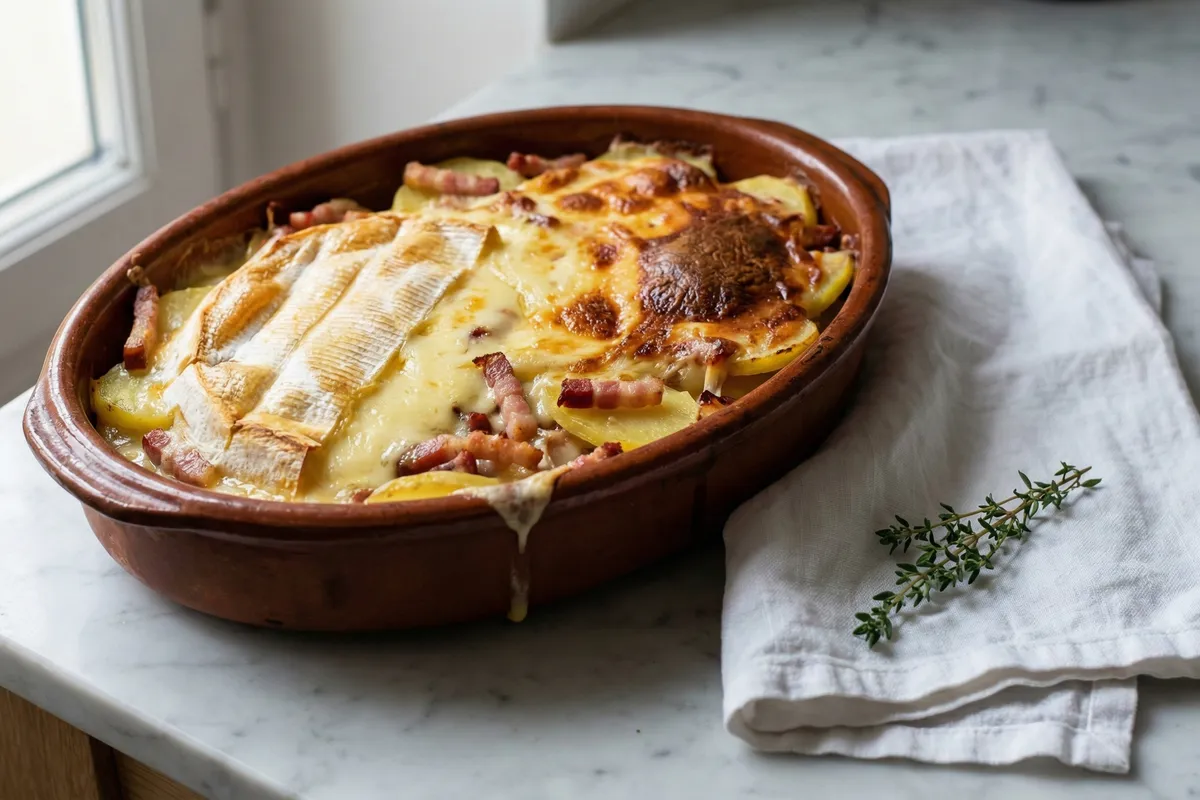
The method is straightforward: sliced potatoes, softened onions, and smoky lardons (lardons fumés) are layered in a gratin dish, moistened with dry white wine and crème fraîche, then crowned with a whole Reblochon cut in half and placed cut-side down. As it bakes, the cheese collapses into the potatoes in a rich, molten layer while the rind turns golden. It is hearty, unpretentious food — exactly what you want after a day in the cold.
Instructions
-
Preheat the oven to 200C (400F).
-
Bring a large pot of salted water to a boil. Cook the potatoes whole and unpeeled until just tender when pierced with a knife, about 15-20 minutes depending on size. They should still have some firmness — do not overcook them, as they will continue cooking in the oven. Drain and set aside until cool enough to handle.
-
While the potatoes cook, prepare the lardons and onions. Place the lardons in a cold, dry skillet over medium heat. Cook, stirring occasionally, until the fat renders and the lardons are golden and lightly crisp at the edges, about 6-8 minutes. Transfer to a plate with a slotted spoon, leaving the rendered fat in the pan.
-
Peel and slice the onions into thin half-moons. Add them to the lardon fat in the same skillet. Cook over medium-low heat, stirring often, until soft and translucent, about 10 minutes. Do not rush this step — the onions should be sweet and yielding, not browned.
-
Mince the garlic and add it to the onions along with the leaves stripped from the thyme sprigs. Cook for 1 minute until fragrant.
-
Pour in the dry white wine and let it simmer until reduced by about half, about 2-3 minutes. Return the lardons to the pan. Stir in the crème fraîche and season with black pepper. Taste before adding salt — the lardons and cheese will contribute plenty.
-
Peel the cooked potatoes and slice them into rounds about 5 mm (0.25 inch) thick.
-
Grease a gratin or baking dish (roughly 25 x 18 cm / 10 x 7 inches) with the butter. Arrange half the potato slices in an overlapping layer across the bottom. Spoon half the lardon-onion mixture over the potatoes. Add the remaining potatoes and top with the rest of the lardon-onion mixture.
-
Slice the Reblochon AOP in half horizontally through the equator, creating two discs. Place both halves cut-side down on top of the gratin, covering as much of the surface as possible. The rind faces up.
-
Bake in the preheated oven for 20-25 minutes, until the Reblochon is fully melted and bubbling, the rind is golden in patches, and the edges of the gratin are starting to crisp. If the top is not sufficiently golden, switch to the grill (broiler) for 2-3 minutes, watching closely.
-
Remove from the oven and let the tartiflette rest for 5 minutes before serving. This allows the molten cheese to settle slightly and makes it easier to portion.
Tips
- Use a genuine Reblochon AOP, not a substitute. The cheese is the soul of this dish — its creamy texture and mild, nutty flavor cannot be replicated. Look for the green casein label (fermier, farm-made) for the best quality, though the red label (fruitier, creamery-made) is also good.
- Waxy or all-purpose potatoes hold their shape best. Avoid floury varieties like Maris Piper, which can disintegrate. Charlotte, Ratte, or Yukon Gold are excellent choices.
- A dry white wine from Savoie — such as an Apremont or a Chignin made from the Jacquère grape — is the traditional choice both for the dish and for drinking alongside it. Any dry, crisp white wine will work.
- Tartiflette does not reheat particularly well, as the cheese becomes rubbery once cooled and reheated. It is best eaten straight from the oven.
- Serve with a simple green salad dressed in a sharp vinaigrette to cut through the richness. Mâche with walnuts and a shallot vinaigrette is a classic Savoyard pairing.
Seasonal Note
Tartiflette belongs to the cold months in the mountains. In the Savoie, winter means raclette, fondue, and tartiflette — the great trio of Alpine melted-cheese dishes that sustain skiers and mountain dwellers alike. Reblochon AOP is produced year-round, but it is during winter that demand peaks and the cheese finds its highest purpose. The potatoes are from the autumn harvest, stored through the cold months, and the smoky lardons reflect the French tradition of winter pork preservation. This is a dish shaped entirely by the Alpine climate: rich, warming, and built to restore energy after a day in the snow.