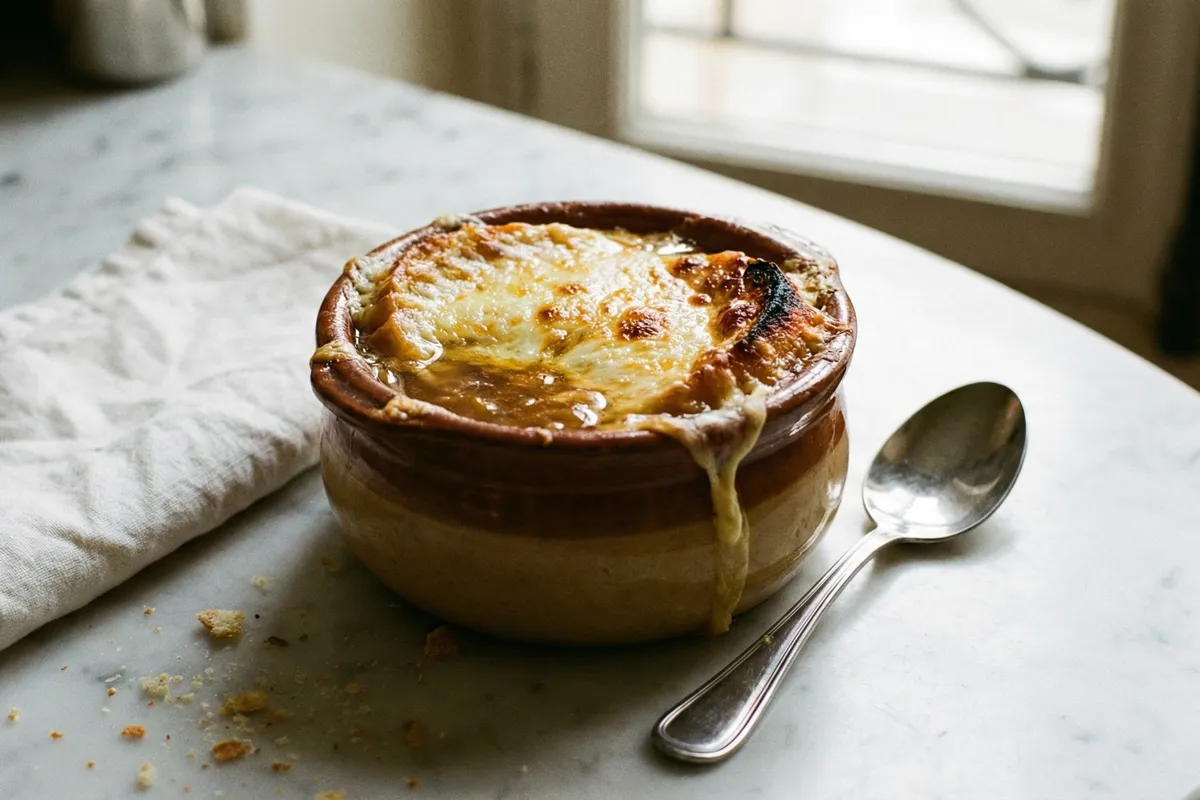
French Onion Soup
Soupe à l'Oignon Gratinée
Ingredients
Soup
- 1 kg 2.2 lb onion (yellow or white)
- 50 g 3.5 tbsp butter
- 20 g 2 tbsp all-purpose flour
- 200 ml 0.75 cup dry white wine
- 1.2 L 5 cups water
- 4 sprigs 4 sprigs thyme
- 2 leaves 2 leaves bay leaf
- 5 g 1 tsp sugar
- 1 to taste 1 to taste salt
- 1 to taste 1 to taste black pepper
Gratinée Topping
- 8 slices (about 2 cm thick) 8 slices (about 0.75 inch thick) bread (day-old baguette or pain de campagne)
- 200 g 7 oz Comté AOC
About This Dish
Soupe à l’oignon gratinée is one of the oldest and most enduring dishes in the Parisian culinary tradition. Onion soups have existed in France since at least the Middle Ages — humble fare made from the cheapest and most abundant of vegetables — but the gratinée version, topped with bread and melted cheese then run under a broiler, became legendary through the great central market of Les Halles. For centuries, Les Halles was the beating heart of Parisian food commerce, and the restaurants that surrounded it — Au Pied de Cochon, Chez Baratte, La Poule au Pot — served gratinée des Halles at all hours. It was the sustaining breakfast of the forts des Halles, the burly porters who hauled crates through the predawn cold, and the restorative last meal of revelers stumbling out of cabarets in the small hours. Though Les Halles moved to Rungis in 1969, the soup endures as a defining dish of the Parisian bistro.
The key to a good soupe à l’oignon is patience. The onions must be caramelized slowly and deeply — forty-five minutes at minimum, with no shortcuts. This long, gentle cooking transforms sharp raw onions into a sweet, amber, intensely savory base that carries the entire soup. Rushing the process with high heat produces charred, bitter onions and a thin broth. There is no substitute for time. The gratinée finish — thick slices of bread soaked in broth and blanketed with Comté AOC from the Jura mountains — turns a simple soup into a meal.
Instructions
-
Peel the onions and slice them in half from root to tip. Place each half cut-side down and slice into thin half-moons, about 3 mm (0.125 inch) thick. Aim for even thickness so they cook at the same rate.
-
Melt the butter in a large heavy-bottomed pot or Dutch oven (cocotte) over medium heat. Add all the sliced onions and stir to coat them in the butter. The pot will seem very full — this is normal, as the onions will reduce dramatically.
-
Cook the onions over medium heat, stirring every few minutes, for about 10 minutes until they begin to soften and release their liquid. The onions will wilt and collapse to roughly half their original volume.
-
Reduce the heat to medium-low. Continue cooking the onions, stirring every 5 minutes or so, for 40-50 minutes. This is the critical step. The onions should gradually turn from translucent to golden, then to a deep amber brown. Scrape the bottom of the pot regularly with a wooden spoon to incorporate the fond — the sticky caramelized layer that forms on the base. If the fond darkens too quickly or the onions threaten to burn, add a splash of water and scrape it up. After about 20 minutes, sprinkle in the sugar to encourage even caramelization.
-
When the onions are deeply caramelized — soft, jammy, and rich amber in color — sprinkle the flour over them. Stir constantly for 2 minutes to cook out the raw flour taste and coat the onions evenly.
-
Pour in the dry white wine and stir, scraping up any remaining fond from the bottom of the pot. Let the wine simmer for 2-3 minutes until mostly absorbed.
-
Add the water, thyme sprigs, and bay leaves. Bring to a gentle boil, then reduce the heat to low. Simmer uncovered for 20 minutes to allow the flavors to meld and the broth to develop body. Season with salt and freshly ground black pepper. Taste and adjust — the soup should be deeply savory and slightly sweet from the onions.
-
While the soup simmers, prepare the gratinée topping. Preheat the grill (broiler) to high. Slice the baguette or pain de campagne into rounds about 2 cm (0.75 inch) thick. Arrange the slices on a baking sheet and toast under the broiler for 1-2 minutes per side until golden and dry. Watch carefully — they can burn quickly. Set aside.
-
Grate the Comté AOC on the large holes of a box grater.
-
Remove and discard the thyme sprigs and bay leaves from the soup. Ladle the hot soup into four ovenproof crocks or deep bowls, filling them about three-quarters full.
-
Place two toasted bread slices on top of each bowl, pressing them gently so they sit on the surface of the soup and begin to absorb the broth. Divide the grated Comté evenly over the bread, covering the surface generously and allowing the cheese to reach the edges of the bowls.
-
Place the crocks on a sturdy baking sheet and set them under the hot broiler, about 10 cm (4 inches) from the heat source. Broil for 3-5 minutes until the cheese is bubbling, golden brown, and blistered in spots. Watch constantly — the difference between perfectly gratinéed and burnt is a matter of seconds.
-
Remove carefully — the crocks will be extremely hot. Let them rest for 2-3 minutes before serving. Warn your guests that the bowls and soup are scalding.
Tips
- The onion caramelization cannot be rushed. Low and slow is the only path to the deep, sweet, complex flavor that defines this soup. If you find yourself tempted to raise the heat, resist. Forty-five minutes is a minimum; an hour is better.
- Use a mix of yellow onions for sweetness and depth. Some cooks add a shallot or two for complexity, which works well given that shallots (échalotes) are a staple of French cooking.
- A day-old baguette or pain de campagne is ideal for the croutons — fresh bread turns soggy too quickly. If your bread is fresh, toast the slices until thoroughly dry and crisp.
- Comté AOC from the Jura mountains is the preferred cheese. Its nutty, complex flavor and excellent melting properties make it superior to generic Swiss-style cheeses. A Comté aged 8-12 months strikes the right balance between flavor and meltability. Younger Comté melts more easily; older Comté brings more depth.
- This soup pairs beautifully with a dry white wine — the same you used for cooking. A Burgundy Aligoté, a Mâcon-Villages, or a Savoie Jacquère all work well.
- Leftover soup (without the gratinée topping) keeps refrigerated for up to three days and the flavor only improves. Reheat and add the bread and cheese just before serving.
Seasonal Note
Soupe à l’oignon gratinée is winter food in its purest form. Onions (oignons) are available year-round in French markets, but this soup belongs to the cold months, when a deeply warming bowl under a molten cap of cheese is not merely welcome but necessary. The dry white wine (vin blanc sec) and butter (beurre) that build the base are pantry constants, while the thyme (thym) and bay leaf (laurier) of the bouquet garni provide the aromatic backbone that French cooks have relied on for centuries. Comté AOC, produced from the raw milk of Montbéliarde cows in the snow-covered Jura, is itself a winter cheese tradition — aged in vast cellars and at its most comforting when melted and bubbling. This is the kind of cooking that made Les Halles famous: simple ingredients, honest technique, and the patience to let time do the work.